An essential part of everyday health—helping maintain fluid balance, support immune defenses, and absorb dietary fats.
We often hear about the importance of gut health, heart health, and good nutrition, but there’s another essential system working quietly behind the scenes: your lymphatic system. From supporting immune health to maintaining fluid balance, it plays an important role in everyday well-being. So how does it work—and what simple habits can help support it naturally?
What Is the Lymphatic System
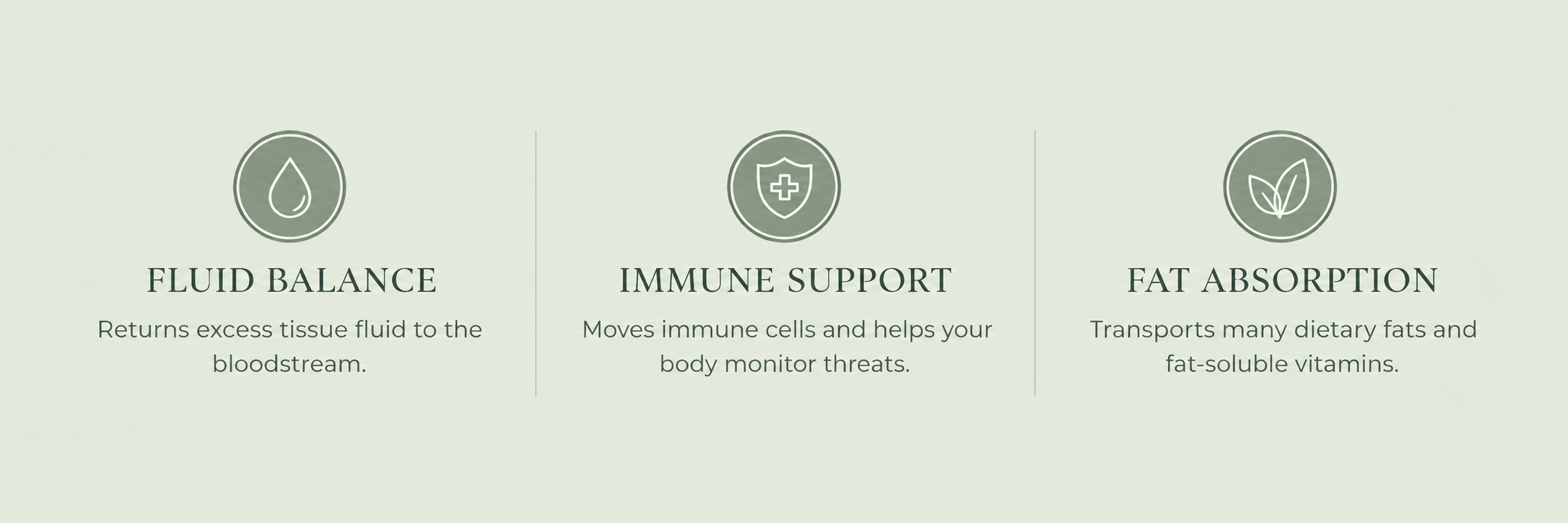
Think of your lymphatic system as a network of vessels, lymph nodes, and organs that works alongside your circulatory and immune systems. It has three important jobs:
Unlike your cardiovascular system, your lymphatic system has no single central pump like the heart. Lymphatic vessels have their own rhythmic contractions, and one-way valves, breathing, and muscle movement all help lymph travel through the body. [1]
The Surprising Link Between Lymph & Nutrition
Here’s something you might not know: much of the fat you eat first travels through your lymphatic system.
During digestion, many dietary fats are packaged into particles called chylomicrons. They enter tiny intestinal lymph vessels called lacteals and travel through lymph before reaching the bloodstream.
This pathway also helps your body absorb the fat-soluble vitamins A, D, E, and K. Some smaller fats take a different route. [2]

What New Research Is Discovering
Researchers are discovering that lymphatic vessels in the gut do much more than move fluid. They transport dietary fats and immune cells and are involved in processes related to inflammation and metabolism. These findings are strengthening our understanding of the connections between gut health, immune function, and the lymphatic system. [2]
Scientists are also exploring the brain’s natural fluid-clearance pathways. In a small 2025 human study, 12 weeks of cycling were associated with changes in MRI-based measures of these pathways. [3] Although the study did not examine massage, it offers an encouraging new direction for research on movement and fluid regulation. There is still much to learn, and each discovery helps us better understand how interconnected the body’s systems really are.
Simple Ways to Support Your Lymphatic Health
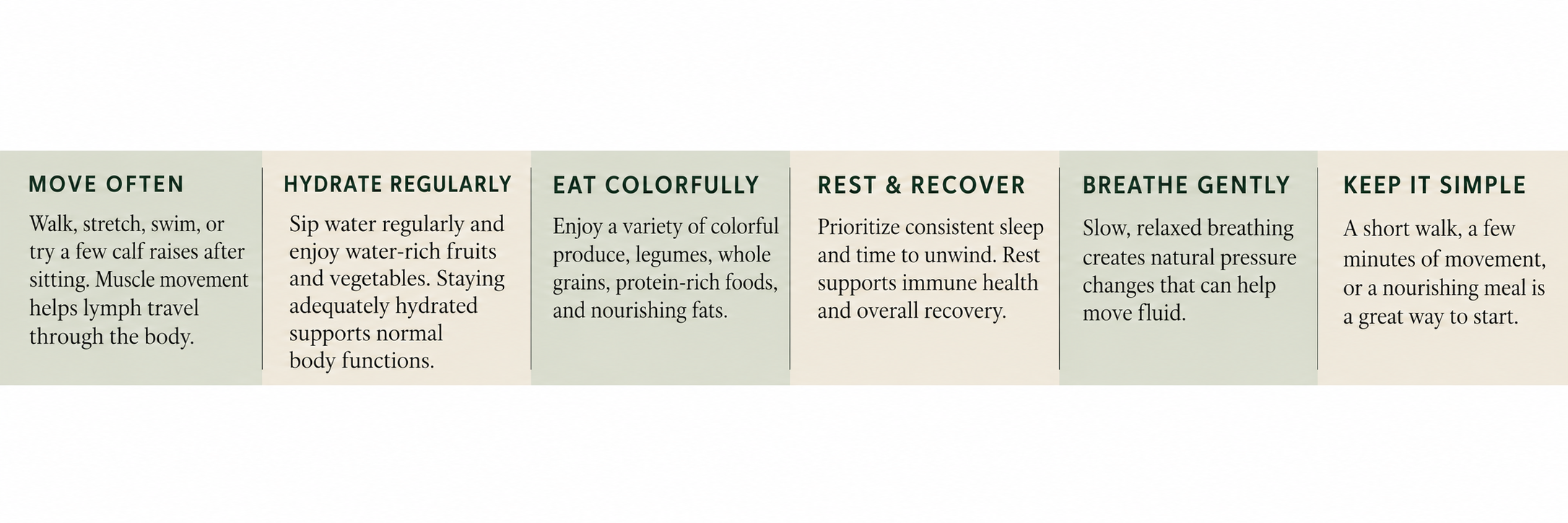
Supporting lymphatic health doesn’t require a complicated routine. Small, familiar habits that nourish your whole body are a wonderful place to begin.
What About Tapping, Dry Brushing & Massage?
Gentle touch can be another comforting way to care for yourself. Dry brushing helps exfoliate the skin and may feel refreshing, while light tapping can be a pleasant self-care ritual. [4]
Gentle lymphatic massage, also known as manual lymphatic drainage (MLD), has valuable therapeutic uses. This specialized technique uses light, rhythmic movements to encourage the movement of lymph fluid. It is a recognized part of comprehensive lymphedema care, often combined with compression, movement, and skin care. Studies suggest it may help relieve pain or discomfort, and in some cases provide additional swelling reduction, although results vary from person to person. [5–7]
Gentle massage can also be a soothing opportunity to slow down and relax. Research on massage more broadly suggests it may help ease anxiety in some settings, although studies specifically showing improved lymph drainage in otherwise healthy adults are limited. [8] The comfort of a relaxing self-care practice can still be a meaningful benefit.
A gentle approach is best. Avoid forceful pressure, and check with your healthcare professional before lymphatic massage if you have unexplained swelling, an active infection, a blood clot, or a serious heart or kidney condition. [9]

A LITTLE MOVEMENT CAN GO A LONG WAY
Free Download: 10 Gentle Lymphatic Flow Exercises
Enjoy my simple, easy-to-follow exercise guide with gentle movements you can work into your everyday routine.
NOTE FROM NOURISH & ROOTED
Nourishment That Fits Your Life
Your lymphatic system is working for you every day. You don’t need a complicated wellness plan to care for it. Moving often, enjoying nourishing foods, staying hydrated, breathing gently, and making time for rest are meaningful ways to support your whole body. Start with one small habit you enjoy, and build from there.
Looking for personalized nutrition and wellness support? I’d love to connect. Reach out to me at Nourish & Rooted to learn more about my programs and discover ways to make nourishing habits fit your everyday life.
www.nourishandrooted.com | Jennifer.nourishandrooted@gmail.com
Real food. Real life. Lasting habits.
Research and References
Peer-reviewed research indexed in PubMed and educational resources from the National Institutes of Health. Select a reference to open its source.
Selected peer-reviewed research and clinical guidance from established medical institutions.
01 Davis MJ, Zawieja SD, King PD. (2025). Transport and immune functions of the lymphatic system. Annual Review of Physiology. PubMed ↗
02 Tso P, et al. (2025). Transport functions of intestinal lymphatic vessels. Nature Reviews Gastroenterology & Hepatology. PubMed ↗
03 Yoo R-E, et al. (2025). Long-term physical exercise facilitates putative glymphatic and meningeal lymphatic vessel flow in humans. Nature Communications. PubMed ↗
04 Cleveland Clinic. (2021). The truth about dry brushing and what it does for you. Read ↗
05 Thompson B, et al. (2021). Manual lymphatic drainage treatment for lymphedema: a systematic review. Journal of Cancer Survivorship. PubMed ↗
06 Lin Y, et al. (2022). Manual lymphatic drainage for breast cancer-related lymphedema: a systematic review and meta-analysis. Clinical Breast Cancer. PubMed ↗
07 National Cancer Institute. Lymphedema and cancer: treatment and self-care guidance. NCI ↗
08 National Center for Complementary and Integrative Health. Anxiety and complementary health approaches: what the science says. NCCIH ↗
09 Cleveland Clinic. (2024). Lymphatic drainage massage: benefits, precautions, and who should avoid it. Cleveland Clinic ↗
Educational note: This article offers general wellness information and does not replace individualized medical advice.